

Speaking of the S&P 500… has your news feed pointed out that nearly all of the gains in that index over the last decade have been from just six companies? Nvidia, Apple, Microsoft, Amazon, Google, and Facebook. Seven in the months when Tesla is on an upswing.
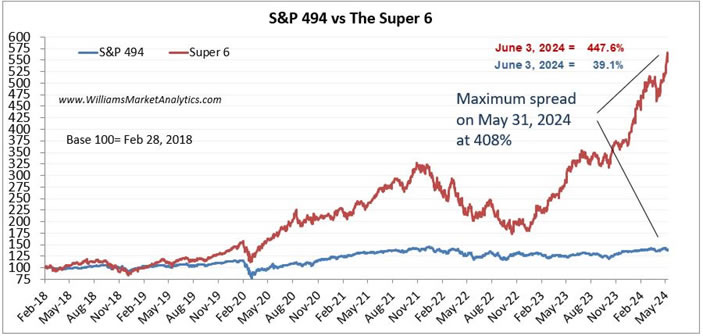
As of last year (the latest chart I could find), the other 494 companies in the index were up only 39% from 2018.
Searching a bit deeper, the following chart (attributed to Goldman Sachs) shows this trend goes back to 2005.
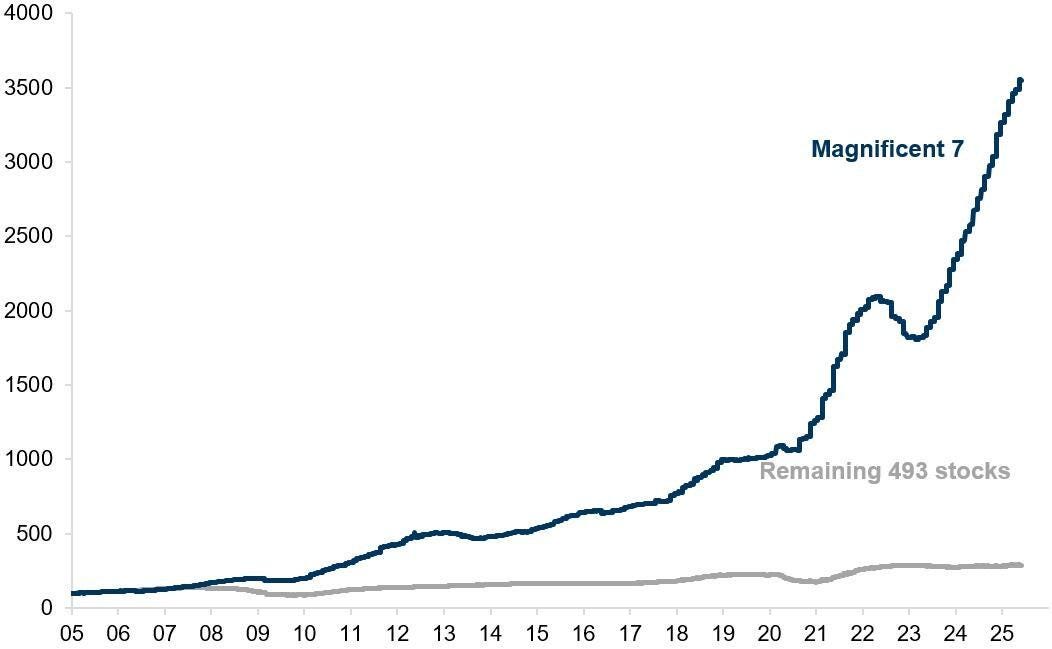
I was in my twenties during the dot com bubble. I’m old enough to have heard “This time is different” more than twice. This run up doesn’t feel at all like the dot-com bubble. This time these gains are driven more by monopoly profits rather than hopes and dreams of future returns.
But nonetheless this feels quite bubbly and unsustainable to me.
I’m not a wealth advisor (nor even employ anyone of that persuasion) but if my portfolio were heavily weighted in these “magnificent” seven companies, I’d be looking beyond the S&P 500 and beyond the shores of the New York stock exchanges to diversify my nest egg.
If I learned anything from the dot-com bubble, it is better to give up the top of the gains rather than still be playing when the music stops and you discover the game is musical chairs, with no chairs left for anyone to sit in.
This is a common topic. However, the S&P 500 is always top heavy. There is a video which shows the rotation of the top ten S&P 500 companies since the 1980s, which should be referenced when one get's tempted to replicate a basket of the Mag 7, or becomes envious of their returns. What's new is that these companies are cash-generating machines, some have diversified revenue streams (AWS, Apple Services, diversification across enterprise, consumer, and cloud), and are global in their operations. I will say that I am a shareholder in META, which I will hold for the next 20-30 years. I wonder if some companies won't have the staying power (NVIDIA and Broadcom) and may go the way of Cisco in the 90's, though NVIDIA's last quarter net income was equal to the last years same quarter revenue. Others early in the cycle will join, some of which are still private. It's still an interesting point in human history, and I am excited to attend NVIDIA GTC here in DC next week to learn more (lots of applications for robotics as well, and there are different methods to train different types of robots, but NVIDIA has a simulator called the ISAAC sim).
Your comment on monopoly power is questionable, a good example are the new DPU chips which accelerate the GPU's. Both Microsoft and NVIDIA have been sued by a company, Xockets, which in part founded these chips. My understanding of antitrust is basic, but I believe the precedent was set with eBay in the late 90's and the litmus tests are now more varied while the threshold needed to be met is higher than before. Many of these cases end up in the Western District of Texas and you can look them up, including the Xockets cases—these are incredibly interesting to read through and insightful for a broad understanding of the US system and innovation. In the case of Xockets, there was both an antitrust suit (less difficult to prove in this case, but the motion to dismiss by Microsoft was effective, and I don't recall the decision of the appeal) and then a separate patent infringement suit (typically more difficult to prove).
You made a small point, but I agree that the majority of the population does not need a wealth advisor, and one's long-term return is significantly lower with the management fees. The industry is starting to democratize, but it will take time to get people educated and in some cases, into the system altogether (which also helps boost the GDP of emerging economies). Not a comment on wealth management, but a good example is Visa Pay, which recently brought banking and credit access to the DRC. A bit of a tangent, but Visa is also interesting in that it will take charge of a percentage of the payment rails domestically as stablecoins become standard over the next few decades, while continuing its global growth. There seem to be only three rails that have existed: ACH, wire transfer, and credit card processing (which began to saturate the market in the 80's and e-commerce in the 90's), and checks/cash/private closed-loop networks (Paypal, Zelle). Many countries already have stablecoins, the publically issued E-Yuan now has over $7T USD flowing through it). The United States will likely go the private route, and USDC will act as the invisible plumbing and absorbed into the traditional rails for banks, though FedNow already exists, but it's centralized. The 3% fees for merchants will drop to perhaps a single digit basis point number (and speaking broadly not just with respect to merchants for Visa, but the underlying network of USDC on Ethereum is nearly free—over 500 million USDC transactions in just early 2025), settlement will become instant, and Visa will manage processing, regulatory, and oversight. It's paradoxical for Visa, but it's also a large trust and settlement network.
Outside of a permanent fixed allocation to a Total International Index Fund, the only other sizable international investment in which I’m an investor/shareholder of is Sea Limited, though it’s based out of Singapore and listed on the NYSE. This is a conglomerate with a large e-commerce platform and gaming division. I keep an eye out for select investment international companies for investment on a long-term time horizon.
An investor in African indices/ETFs/public-traded or private companies should be aware of the correlation to the US economy and S&P 500 (though those two in themselves aren’t perfectly correlated). Those yearly returns for pure publicly-traded African companies will be just as extreme towards the downside, and may stay that way for years. Alpha exists in emerging markets, but it’s not free and it is not easy to discover.
The above doesn’t mean these companies are a poor investment, but one must hold for the long-run to reap the reward of the additional risk. However sound fundamentals may be, the market decides price, and in a downturn it won’t be similar to the US where capital flows to an equity safe-haven such as Utilities, and of course, Treasuries. As a side note, if one is buying bonds or a bond fund, they must be treasuries as treasuries are the pure-play investment. Treasuries will zig when equities zag, especially the longer one goes in duration. It's quite interesting, but a 90/10 or 95/5 fund with long-duration treasuries tends to outperform in the long-run vs. pure equities. MBS and corporates, which are packaged into Total Bond funds have higher risk and higher correlation to equities.
Anyways, I suspect it’s all about growing Tuesday Markets, appealing to the fundamental and continued growth for each bizi, appealing to a less-rigid younger demographic (not to preclude older investors) and investors in both Africa and abroad, all while making long-term inroads in the institutional space. The story is there and it’s exciting, but African investing doesn't have the same buzz as Tech or Crypto, though the far long-term future may look very different as technology continues its acceleration, and there is overlap with technology as it's is implemented into the systems of these companies (I think we've seen that with East Africa Foods as it's scaled). This also seems to imply a need for strong marketing, connections, and polish—though one can't lose sight of the more important fundamentals and quality. One benefit is that this industry is less cyclical from a non-market perspective, so it allows a less-hyped, and more consistent/sound retail investor base.
It is fascinating what sells, what doesn’t, and why. Consider the excess of ETFs and funds in the market, many of which rely purely on marketing—some do drive a rather immaterial amount of capital to innovative areas. Look at AQR Capital’s returns (unproven quantitative strategies). Remember the SPAC era? Speaking of which, Chamath is raising another fund. Piece together the long-term returns on any mid-size Tiger Cub fund out of New York, some of which have a history of not succeeding in the long-run (Julian Robertson himself eventually shut down and returned capital), though Tiger Global does seed similarly to Sand Hill Road. On the other side, funds based on fundamentals and manager character such as Pershing succeed irrespective of short-term yearly returns.