

I’ve attended, spoken at, and sponsored many dozens of conferences in my 30+ year career. Most have been worth my time. Mostly due to the fact that I attend global conferences where people fly in across multiple continents, and thus I can meet people face-to-face who I’d otherwise only ever meet over Zoom.
That said, most conferences focus on programming rather than networking.
Back when I was attending SOCAP, 2000+ attendees could choose from 12 simultaneous panel discussions. Sankalp Africa hosts six simultaneous panels for 1,400 attendees. I did something similar when I created the first-ever SOCAP 365 PNW conference in Seattle back in 2018, with three simultaneous panel for just 220 attendees.
What I discovered in talking to fellow conference attendees is that these panels attract conference newbies, while the conference veterans ignore any panel where they are not speaking, and instead focus on networking.
Post-pandemic I’ve seen better support for that behavior from some conference organizers, with conference apps providing a method for messaging other attendees if not setting up meetings. But more often than not that software is hard to use and not used.
Then there is AFSIC, an annual conference in London for investors investing in Africa. AFSIC is focused first and foremost on networking, and wow, does it deliver. Anyone who organizes conferences should be copying their style.
The website doesn’t make this obvious. It shows an agenda of panels and speakers, like other conferences. But note that there is one track of agenda items that is “Meet the ____” which is just a room full of cocktail party tables and a chance to quickly meet a dozen investors of a specified theme, with that theme shifting every hour. Look at the map and you’ll see the largest room is full of meeting tables, and the smallest room is for panels.
What you can’t see without being an attendee is that the conference app is far more focused on connections and meetings. It still isn’t perfect, but it splits the day into 30 minute slots and makes it quite easy to fill those slots with face-to-face meetings.
18 slots on Day 1 and 14 slots on Day 2. 32 possible scheduled meeting times.
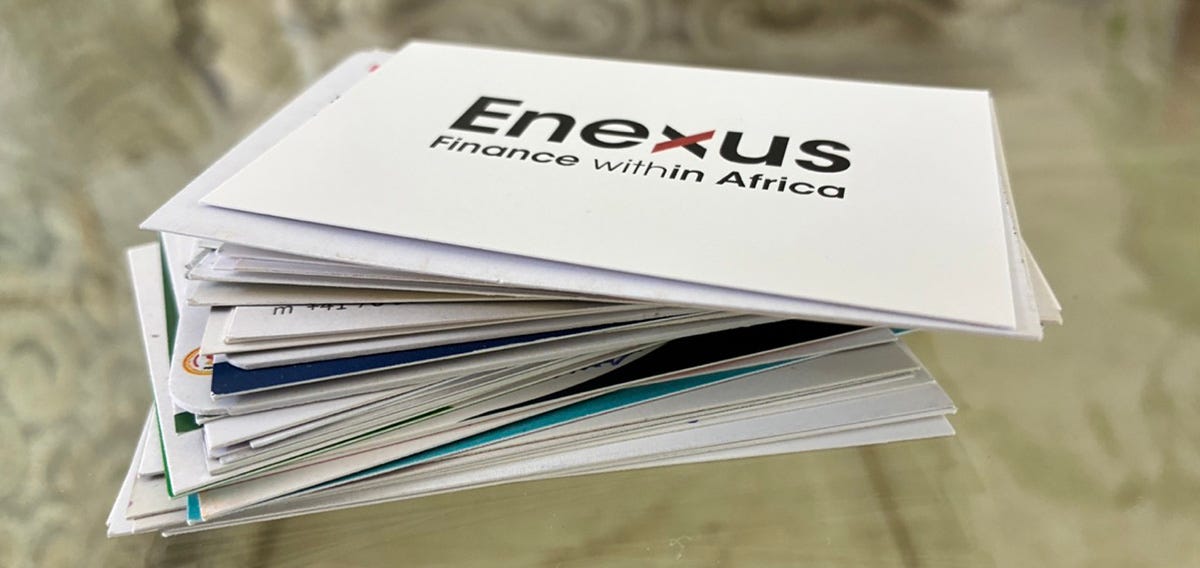
In two days I filled all but two or three of those slots with scheduled meetings, but as seen above, collected 42 business cards. In two days I met at least 50 people. I don’t have the exact count as not everyone carries business cards, as many people ran out by Day 2, and as this doesn’t count the quick catch-up meetings with people I’ve met before.
This event is my benchmark for the efficiency possible at a conference. A level of efficiency unmatched by any other conference I’ve ever attended?
Are there other events organized like this? If so, please share in the comments.