

One of the challenges most African government face is the fact that much (if not most) of the economy runs through informal businesses. Informal businesses are not easily taxed, nor are the incomes generated from those businesses.
Taiwan, one of the Asian Tigers, solved its tax collection challenge in a novel way, back in 1951, in a way that made customers demand a receipt for every transaction.
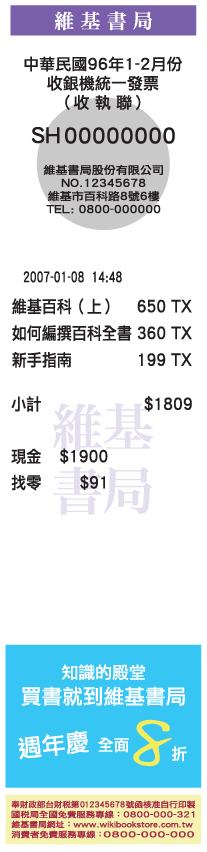
Specifically, the government required all businesses to use a receipt generator licensed by the government. Alone that would have been mostly ignored. The genius move was including some random numbers of each receipt, and holding a lottery based on those numbers.
The grand prize is NT$10 million (US$342,000). But there is a wide range of prizes too. So many that just about everyone knows someone who has won a prize. So many that no one ever leaves a shop without a receipt.
With that, the government can track nearly every transaction on the island, by company, and can thus estimate the proper VAT and other taxes due from each company.
What I don’t understand is why this isn’t ubiquitous across Africa. Are there cultural taboos against lotteries? In this day and age of mobile money, there doesn’t even need to be paper receipt printers. Just tack a randomly generated number to each transaction, text the winners, and put the winnings direclty into their mobile wallets.
Or in general, I don’t understand why every emerging market country hasn’t copied the best ideas of other countries. Why not 100 countries with digital citizenship like Estonia? Why is M-Pesa the only mobile money that is ubiquitous? Why is Brazil the only country with a special businsss-to-business trading system (and does anyone remember its name, neither Google nor its AI can find it for me.)
In fact, there is a cultural taboo against lotteries. The Koran forbids any form of gambling, including lotteries. Practising Muslims wouldn't be able to participate.
A possible solution to this could be that any Muslim who wins could have the money donated to a selection of charities or the Ministry of Health, Ministry of Education, etc. I am not a Muslim so I don't know if this would be allowed but, potentially, this could be a work-around. Granted, there is less personal incentive this way, which is how Taiwan's program worked so well.
This idea by Taiwan is a good one. There must be some way to modify it so it could work in at least some African contexts. Maybe not Senegal but maybe Malawi?