

What is any given company worth? That is a simple question with no definitive answer and no definitive method for answering. In Part 1 we learned “it depends” and in Part 2 we saw that sometimes it depends on the investor.
To find a better answer, let’s turn to Berkshire Hathaway, the most successful public investment company of all time, with 60+ years of track record buying both minority interests in public companies and majority interests in both private and public companies. A company the market recently valued at over $1 trillion.
And let’s let Buffett and Munger answer this question in their own words (watch at least through 3:05):
As Buffett explains, Berkshire Hathaway looks at financial statements, looking into the past to try and predict what the future financial statements will look like.
At 2:30, Munger chimes in to point out that Berkshire Hathaway likes companies that “drowns in cash.”
And then “Professor” Buffett makes this even clearer at 3:05 when he gives the example about the cashflow of owning an apartment rental.
All of this makes sense for an investment company that only invests in slow-growing, stable, established companies in well-developed market segments. And even more sense you understand that Berkshire Hathaway generally only buys such companies when something has happened recently that would merit the price to be lower than normal.
For example, Berkshire Hathaway bought its 9.3% of Coca-Cola just after the debacle with New Coke. It bought its 21% of American Express after some fraud crashed the price of that company. It owns 9.3% of Bank of America from a for-profit bailout in the 2008 financial crisis.
Remember Apple’s PE ratio of 36? Berkshire Hathaway bought Apple back at a PE ratio below 10. The U.S. 90-year average PE ratio is 17.7. Below are the PE ratios when Berkshire Hathaway purchased shares in those companies.
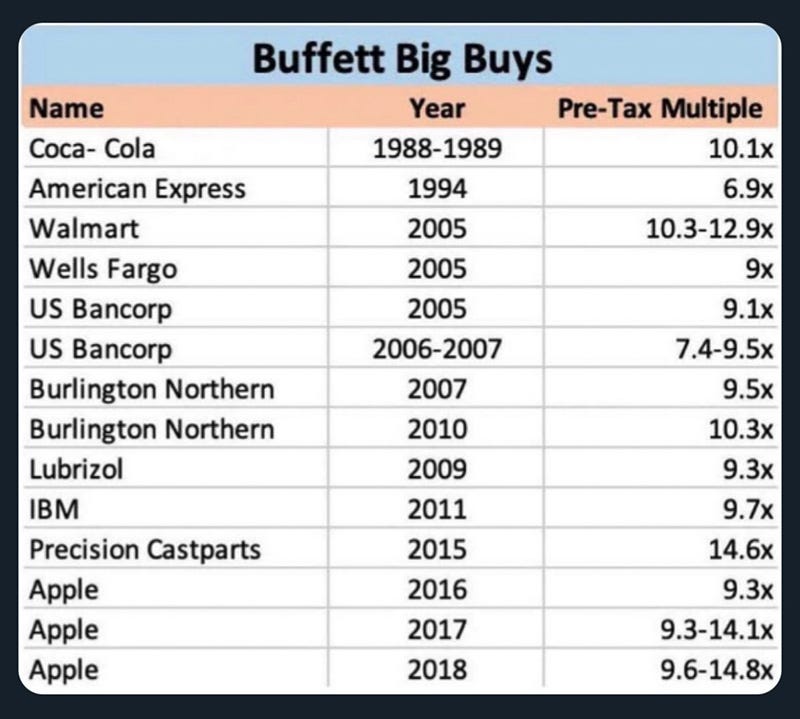
This is the “margin of safety” that both Buffett and Munger often talk about. A strategy that goes back to Benjamin Graham, Buffett’s professor, mentor, and long-ago employer. If the market undervalues an otherwise good company, then buy now, hold for years (if not forever) and someday the market value will catch back up.
A few other good lessons in this video:
At 2:03 Buffet surprisingly says they’ve bought businesses without ever meeting management. As someone who spent his career in the VC ecosystem (on both sides of the table) I find that amazing, as VC’s first, second, and third criteria is “team.”
If you kept watching the video, at 6:38 Buffett talks about all the incoming requests from managers trying to sell their companies to Berkshire Hathaway. “They imply their business is the most attractive in the world… it isn’t.” I see similar attitudes from startup founders.
At 7:10 Buffett explains that when the rare opportunities to buy whole businesses arise, they are at fair prices, not bargain prices.
How to Value a Company?

What is any given company worth? That is a simple question with no definitive answer and no definitive method for answering. The best anyone can say is “it depends”.
How VCs Value a Company?

The first post in this series TL;DR is “it depends,” but valuation also depends on who you ask. Venture capital funds have their own unique way of valuing companies, which is far more about their business model than the companies that they are investing in.
BTW, this Berkshire Hathaway video is from their annual Shareholder Gathering in Omaha. Buffett and Munger (and for the past two years Buffett and Abel) answer questions from the audience for hours at these meetings. The team gets no warning on what the questions might be, and I’ve yet to ever see a question evaded, although some answers go on for 20 minutes and end up unrelated to the original question. These Q&As have been happening for 60 years and have been streamed live and downloadable on CNBC in recent years.
10x P/E sounds like a great company at a fair price.